My Trades
Everyone Says SpaceX Is Overpriced. Here's How I Bought It Anyway.
I wanted to own a piece of space. I did not want the stress of a $219,000 stock position. So I built one that controls that much stock, risks about $26,000, and lets me sleep at night.
The tipping point
The Moonshots podcast was what pushed me over the edge. The more I listened, the more convinced I became that space is one of the defining industries of the next decade, and that SpaceX is the company leading it. I decided I wanted to own it.
The problem? Almost every pundit and analyst says the stock is “priced to perfection.” Maybe they're right. A stock this hyped can drop hard on any piece of bad news, or simply because the whole market sells off.
So I didn't chase the IPO. I let the excitement run up and shake out, and started buying when SpaceX was trading around $140 a share. When it dipped into the low $100s, I bought more.
Why I didn't just buy the shares
My position gives me exposure to about 1,500 shares of SpaceX, roughly $219,000 worth at today's price. If I owned that much stock outright, here's the question that would keep me up at night:
That's an $87,000 loss on the shares. I know myself. A drop like that would put tremendous pressure on me, and I would be tempted to sell. Worse, I'd let the falling price change my opinion of the company, even if nothing about the business had changed.
I call that behavioral risk, and it's the biggest risk most investors face. Not the stock. Themselves.
What I bought instead: long-dated call debit spreads
If you're not familiar with them, a call debit spread has two parts:
- I buy a call option, which gives me the right to buy SpaceX at a set price (the lower strike) until a set date.
- I sell a call option at a higher price, which means I agree to sell the shares at that higher price. That caps my upside, but it also lowers what I pay.
The result: I pay a small, fixed amount up front, and that amount is the most I can ever lose. I chose conservative strike prices, most of them well below where the stock trades today, which gives the trade a higher probability of working out. And I spread the positions across three expiration dates, December 2027, June 2028 and December 2028, so my thesis has time to play out.
Here's the actual position in my Schwab account. Don't be overwhelmed by all the lines. The breakdown below makes it simple.
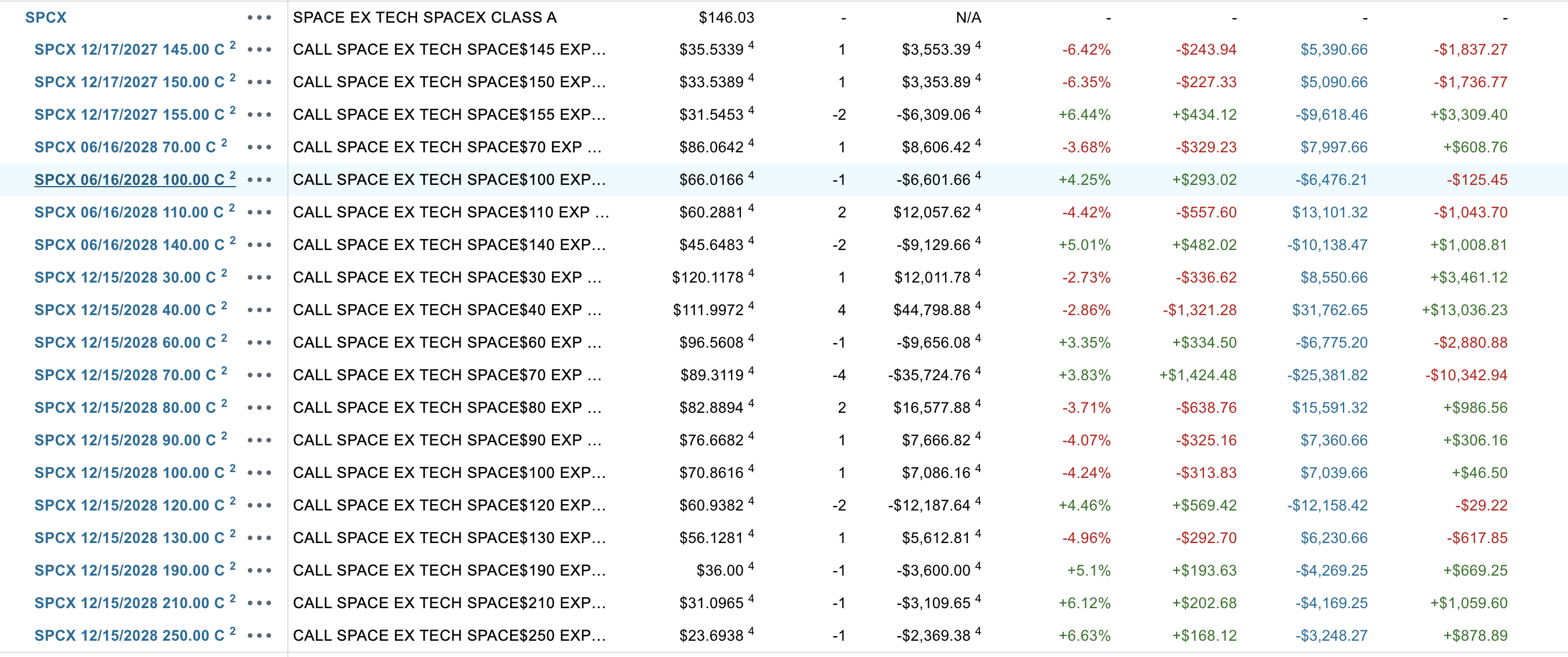
My SpaceX position as of October 16, 2026. Each pair of lines (one bought, one sold) is one spread.
The position at a glance
(my maximum loss)
(about $219,000)
if SpaceX hits $250+
The crash test
This is the comparison that matters. Here's what happens if SpaceX falls 40% and stays there through expiration:
If SpaceX falls 40%, to about $88
Same company, same crash. One loss is life-changing. The other is a bad year.
Even if SpaceX went to zero, I can't lose more than the $25,881 I paid. That's the number I decided I could live with before I placed a single trade.
What could happen from here
Here's roughly what the whole position would be worth at expiration at different SpaceX prices. It's simplified, since it assumes the stock sits at the same price at each expiration date, but it shows the shape of the trade:
Position value at expiration
| SpaceX price | Position worth | Gain / loss |
|---|---|---|
| $88 (down 40%) | $18,300 | −29% |
| $100 | $23,000 | −11% |
| $107.50 | $25,900 | Break-even |
| $146 (today, flat) | $43,900 | +70% |
| $200 | $60,500 | +134% |
| $250 or higher | $66,500 | +157% |
Cost basis $25,881. The stock can fall about 26% from today and I still break even.
Look at the highlighted row. SpaceX doesn't need to go up for this trade to work. If it simply goes nowhere, the position is worth about 70% more than I paid. That's the power of buying conservative strikes: time works for me instead of against me.
The trade-off is the cap. If SpaceX goes to $500, the shareholder makes a fortune and I max out at $66,500. I'm fine with that. I'd rather have a high chance of a solid return with a known worst case than a lottery ticket that keeps me up at night.
Where it stands today
As of this writing, the position is worth about $32,600, up roughly $6,750 (26%) from what I paid. There's still more than a year before the first spreads expire, and a lot can happen. But no matter what happens, I already know my worst case. So I don't have to watch the stock every day, and I won't be forced into a panic sale if the market turns.