My Trades
Are Sky-High Oil Prices an Opportunity? Here's My $17,650 Bet.
Nobody is a fan of these oil prices. Not politicians, not drivers at the pump, not any country. But when life hands the whole world lemons, it's worth asking: is there a way to make some lemonade?
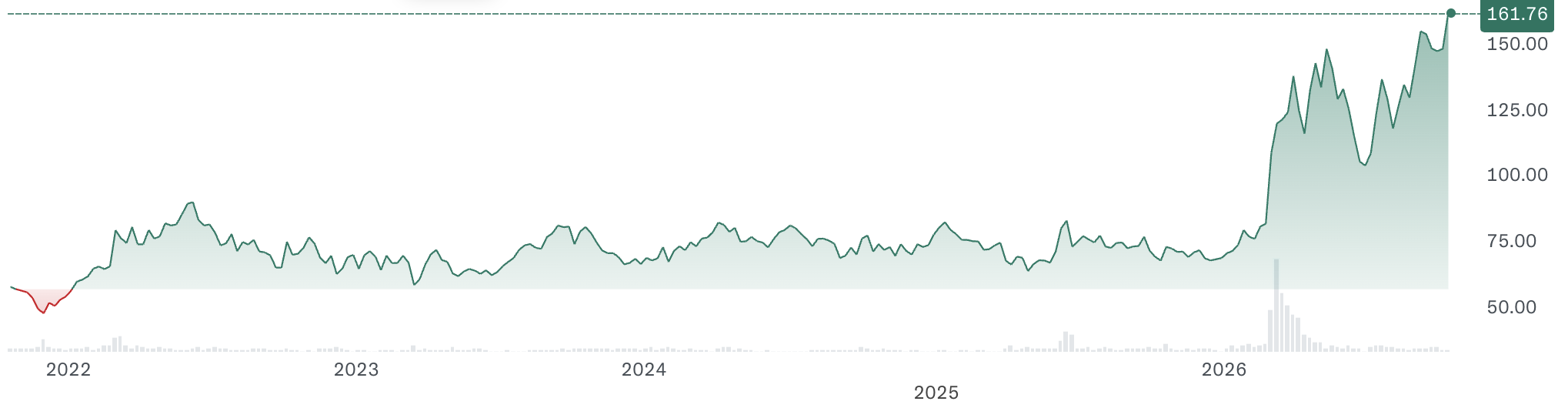
Since the war with Iran began, USO, the fund that tracks the price of oil, has more than doubled. It went to such an extreme, so fast, that I can't help but see an opportunity for when prices come back down.
USO, the last five years
Oil more than doubled after the war began: about $75 to $162
late Feb 2026
← Swipe to see earlier years
USO (United States Oil Fund), 5-year price chart. Data: Nasdaq real-time price, October 2026.
My simple thesis
When prices climb this far, this fast, they eventually come back down. Oil has done it before. In 2008 it hit $147 a barrel in July and was below $40 by December. In 2022, after Russia invaded Ukraine, it spiked above $120 and gave most of it back within months. You can see that 2022 bump on the chart above.
Two things make me believe it can happen again:
- A resolution. At some point, some kind of deal or de-escalation gets worked out, and the war premium comes out of the price.
- Demand destruction. Prices this high aren't sustainable. When oil gets too expensive, people drive less, businesses cut back, and buyers find substitutes. Lower demand eventually pulls prices down on its own.
The real question for investors isn't if. It's when. And because I don't know when, I need to give my thesis time to play out.
What I bought: a conservative bear put spread
If you're not familiar with options, that's okay. A bear put spread is a way to profit if a stock or fund goes down, with a worst case you know in advance. It has two parts:
- I buy a put option, which gains value as USO falls below its strike price.
- I sell a put option at a lower strike price. That caps how much I can make, but it also lowers what I pay.
The result: I pay a fixed amount up front, and that amount is the most I can ever lose, no matter how high oil goes. I chose long expiration dates, September 2027 and January 2028, so the trade has time to work.
Here's the actual position in my Schwab account. Each pair of lines (one bought, one sold) is one spread.

Swipe to see all columns →
My USO position as of October 17, 2026, with USO at $161.76.
The position at a glance
(my maximum loss)
(USO about 5% lower)
if USO is $140 or lower
Want my next trade breakdown?
I share my real positions and the numbers behind them, as I make them.
What USO needs to do
Not much. My break-even is USO at about $153, which is still an incredibly high price. For most of the time since the war began, USO has traded well below that. To earn the full return, USO just needs to be at $140 or lower by my expiration dates. That's still nearly double where it was before the war.
Position value at expiration
| USO price | Position worth | Gain / loss |
|---|---|---|
| $180 or higher | $0 | −100% |
| $170 | $1,000 | −83% |
| $162 (today, flat) | $2,650 | −56% |
| $155 | $5,000 | −17% |
| $153 | $6,000 | Break-even |
| $150 | $7,500 | +25% |
| $145 | $9,500 | +58% |
| $140 or lower | $10,500 | +75% |
Cost basis $6,009. Simplified: assumes USO is at the same price at both expiration dates.
To be clear about the trade-off: this one needs oil to come down. If USO simply stays where it is, the position loses money. That's the bet I'm making, and the table shows exactly what it costs me if I'm wrong.
Why I didn't just short oil
The traditional way to bet against something is to short it: borrow shares, sell them, and hope to buy them back cheaper. The problem is that a short position has no ceiling on losses. In a war, oil can spike on a single headline.
If I'm wrong and oil spikes another 50%, to about $243
Shorting has no limit on losses. With spreads, I knew my worst case before I placed the trade.
Why I kept it conservative
If I wanted an even bigger return, I could have picked lower strikes, like $130. I honestly think USO could fall back below $100 once there's a resolution. But I'm a conservative investor. I would rather set up a trade where oil only has to come down a little for me to earn a great return than swing for the fences and need everything to go right.
I'm in bigger than this
The trade above is the cleanest one to walk through, but it isn't my whole oil position. I also have a second, larger set of put spreads on USO, expiring January, June and December 2028:

Swipe to see all columns →
My second USO position as of October 17, 2026.
Both positions combined
(my maximum loss)
at expiration
if USO is $140 or lower
A maximum gain of about $13,850 (+78%). Same idea, same worst-case math, just a bigger bet.
My plan if oil keeps climbing
If USO gets into the $170s, I'll add to the position. If it climbs into the $180s, I'll add more. Higher prices only make the setup more attractive to me. But I've set a hard limit: the most I'm willing to put into this idea is $40,000. I've already committed about $17,650, so I have roughly $22,350 left to add if oil keeps climbing. Deciding that number ahead of time is what keeps a good idea from turning into an emotional one.
Where it stands today
As of this writing, both positions together are worth about $14,560, down roughly $3,100 (18%) from what I paid, because oil has kept rising. That's okay. I have about a year before the first spreads expire, and I already know my worst case. I don't have to guess when the war ends. I just have to be patient.
Learn how to use long-term options to build positions like this, step by step.See the course →