Options Strategy
How I'd Try to Double $6,000 in Two Years Without Buying a Risky Stock
Imagine you have $6,000 and want to try to double it in about two years. How would you do it?
The way most people try
Most people think you need to buy a high-risk company to have a shot at doubling your money. Some buy a small, speculative stock and hope it takes off. Others buy a beaten-down stock and hope it recovers even half of its old highs.
Either way, the stock has to double for your money to double. That's a big ask, and those are exactly the kinds of stocks that can just as easily fall another 50%. People often pay dearly for these plays.
A different way: a great company, with leverage and a floor
Instead, I'd take a great company I'd be happy to own, like Amazon, or even a broad ETF like XLK, and use a long call debit spread. It gives me leveraged exposure to the stock, but the most I can lose is what I pay up front.
As I write this, Amazon trades at about $262.55 a share. Here's a trade I set up:
- Buy the June 16, 2028 $220 call
- Sell the June 16, 2028 $280 call
- Cost: about $2,975 per spread
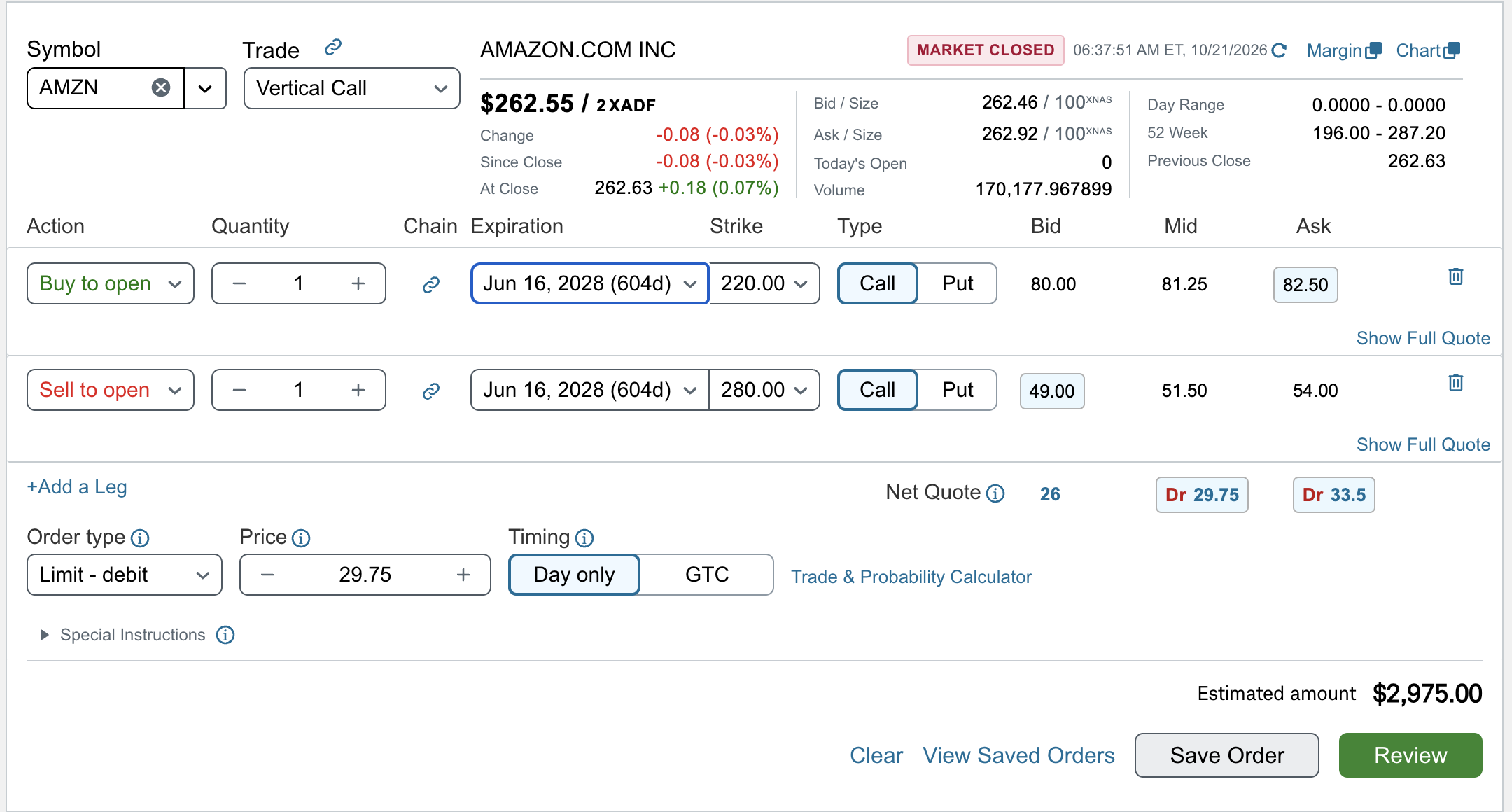
The trade setup in my Schwab account, about 604 days to expiration. Prices are from October 21, 2026, before the market opened.
One Amazon spread at a glance
(my maximum loss)
is $280+ in June 2028
to rise to double my money
So with $6,000, I'd buy two of these spreads for about $5,950. If Amazon is at $280 or higher on June 16, 2028, they're worth $12,000. My money doubles, and Amazon only has to rise about 6.6% from today. A speculative stock would have to double to do the same thing.
How much the stock needs to rise to double your money
What happens at different Amazon prices
Here's what one spread is worth on June 16, 2028, depending on where Amazon closes:
One spread, value at expiration (cost $2,975)
| Amazon price | Spread worth | Gain / loss |
|---|---|---|
| $220 or lower (down 16%+) | $0 | −100% |
| $235 | $1,500 | −50% |
| $249.75 (down 4.9%) | $2,975 | Break-even |
| $262.55 (flat) | $4,255 | +43% |
| $280 or higher (up 6.6%+) | $6,000 | +102% |
Amazon can fall almost 5% and I still get my money back. If it goes nowhere, I'm up 43%.
Now ask yourself: how likely do you think it is that Amazon trades at $280 or higher by June 2028? It doesn't need a miracle. It needs to grow modestly over the next year and a half. To me, that's far more likely than a speculative company doubling.
See how I use spreads like this
Get my real trades by email, including what happens after I place them. No spam.
No spam. Unsubscribe anytime.
The trade-offs
Nothing in investing is free, so here's what I give up:
- My upside is capped. If Amazon goes to $400, a shareholder makes a fortune. My spread still maxes out at $6,000.
- I can lose the whole $2,975 if Amazon finishes below $220, down about 16% from today. That's why I only put a small slice of my portfolio into any one spread and keep most of my money in fixed income.
- The market isn't giving this away. The spread costs about half its maximum value, which tells you the options market sees roughly even odds of it paying in full. My edge is choosing a company I believe in for the long haul, and knowing exactly what I can lose before I place the trade.
Why more investors don't do this
Most investors have never been taught how to use options. They either avoid them because they've heard they're risky, or they use them the wrong way: short-term bets that expire in days or weeks. Used like this, with a long time frame, a great company and a known worst case, options can give you a real shot at outsized returns without betting on a long shot.
If you're new to how I invest and why, start with Why I Only Invest in the Stock Market With Long-Dated Options. It explains how I got here after watching two crashes hit my family's savings.
This is just one of the ways I use long call debit spreads. If you want to learn the whole approach, keep coming back to this blog, or check out The Strategic Investor course, which walks through exactly how I build these positions and size them inside a portfolio.